

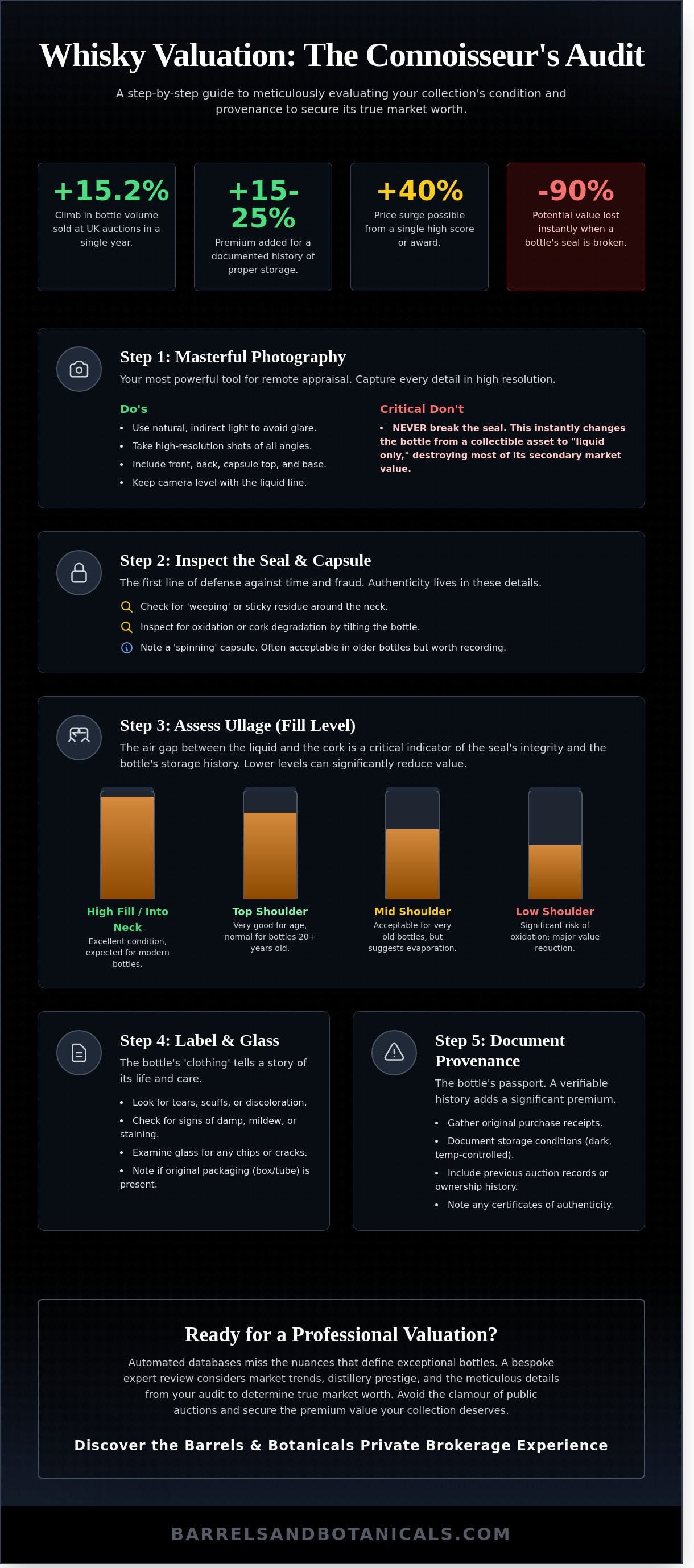
According to the 2024 Rare Whisky 101 report, the volume of bottles sold at UK auctions climbed by 15.2% in a single year, yet many collectors still leave thousands of pounds on the table because they misjudge the "shoulder" of their assets. You recognise that a rare single malt is more than just aged spirit. It's a captured history. A nuanced ritual of oak and time. It's natural to feel a sense of hesitation when managing the delicate physics of a deteriorating cork or the shifting tides of global demand. You value precision and deserve a whisky valuation that reflects the artisanal craft within the glass.
This guide provides the definitive path to an expert appraisal by mastering the meticulous audit of provenance and condition. We'll explore how to assess ullage with surgical accuracy and why specific 2026 market shifts are altering the worth of Highland classics. By the end of this journey, you'll possess a clear, expert-backed understanding of your collection's market worth and a seamless route to a premium sale that honours the liquid's true essence. Amber hues. Peated whispers. The heavy weight of history. Let's ensure your collection is treated with the respect it deserves.
Key Takeaways
- Distinguish between standard retail prices and true secondary market worth by identifying the essential pillars of rarity, age, and distillery prestige.
- Conduct a meticulous physical inspection using a structured audit to document the provenance and condition that define a bottle's ultimate character.
- Navigate the 2026 market shift toward connoisseur-led collecting to ensure your whisky valuation reflects current demand rather than outdated speculation.
- Learn why bespoke expert reviews outperform automated databases when pricing exceptional bottles for the discerning UK market.
- Discover a curated path to sale through private brokerage, avoiding the clamour of public auctions to secure the true £-value of your collection.
Defining the Value: What Makes a Bottle Truly Collectable?
A bottle of rare spirit is more than glass and liquid. It's a liquid archive; a sensory time capsule from a specific season in the Highlands or the peat bogs of Islay. To secure an accurate whisky valuation, you must look beyond the liquid itself to the three pillars of worth: rarity, age, and distillery reputation. While a standard 12-year-old malt serves the palate for a Tuesday evening, a 40-year-old release from a closed distillery serves the portfolio. It represents a finite piece of history.
Don't confuse the price on a London high street shelf with secondary market demand. Retail prices are fixed by global distributors. Secondary values are dictated by the fever of the auction room. A bottle purchased for £180 in 2022 might command £1,450 by 2026 if the demand outstrips the dwindling supply. This Whisky overview explores the foundation of these spirits, yet it's the journey after the corking that defines the final hammer price.
Provenance is the bottle’s passport. A documented history of storage in temperature-controlled, dark environments adds a premium of 15% to 25% over "attic finds." Collectors seek certainty. They want to know the seal is intact, the fill level is high, and the label hasn't suffered from damp. There's a haunting allure to "silent stills" like Port Ellen or Brora, which ceased production in 1983. These bottles offer a dwindling resource. Once they're opened, the world’s supply shrinks forever.
The Rarity Factor: Limited Editions and Single Casks
Rarity is the heartbeat of collectability. Single cask releases, often yielding fewer than 300 bottles, possess a unique DNA. Collectors hunt for "cask strength" and "non-chill filtered" designations. These terms signal purity. They promise an unadulterated experience. Identifying "first edition" labels or retired packaging is vital. A change in label art in 2024 can make the 2023 "old style" bottle instantly more desirable to the completist.
Distillery Prestige: The Blue-Chip Malts
Certain names act as liquid currency. The Macallan, Springbank, and Bowmore are the blue-chip stocks of the spirits world. In the UK market, Speyside malts provide the elegance, while Islay’s smoky profiles drive intense bidding. A single award-winning release, such as a "World's Best" title from 2025, creates a halo effect. It lifts the value of the entire back-catalogue. Whisky valuation thrives on this prestige. High scores from trusted critics can trigger a 40% price surge within a single auction cycle.
The Connoisseur’s Audit: A Step-by-Step Guide to Evaluating Your Whisky
Approaching your collection requires the same patience as the master blender who first barrelled the spirit. This physical inspection isn't a chore; it's a ritual. You're looking for the story the bottle tells through its glass, paper, and seal. Before you seek a professional whisky valuation, you must document every nuance of your asset. Use this my whisky collection checklist to log your findings with precision. This data forms the foundation of your digital portfolio.
Photography is your most powerful tool for a remote appraisal. Capture the bottle in natural, indirect light to avoid glare. Take clear, high-resolution shots of the front label, the back label, the top of the capsule, and the base of the bottle. Ensure the camera is level with the liquid line to show the exact fill level. Never break the seal. The moment that lead or plastic is pierced, the market value plummets. It ceases to be a financial asset and becomes "liquid only," often losing 90% of its secondary market worth instantly.
Step 1: Inspecting the Seal and Capsule
The capsule is the first line of defence against time and fraud. Look for signs of "weeping" or seepage, which often appears as a sticky residue or discolouration around the neck. A "spinning" capsule, where the lead sleeve moves freely around the glass, is generally acceptable in older bottlings but can sometimes indicate a lack of a tight seal. Check for oxidation or cork degradation by gently tilting the bottle. If the cork has crumbled or shrunk, oxygen has entered the chamber, potentially tainting the spirit's profile. Authenticity lives in these details.
Step 2: Assessing Ullage (The Fill Level)
Ullage refers to the air gap between the liquid and the cork. It's a critical metric for any whisky valuation. A fill level "into neck" is ideal for bottles from the 1980s or 1990s. If the liquid has dropped to "mid-shoulder" or "low-shoulder," it suggests poor storage in warm or bright conditions. For those building a serious portfolio, a comprehensive guide to whisky investment clarifies how evaporation rates directly correlate to a bottle's perceived health and future longevity. High evaporation suggests the seal has failed.
Step 3: Label Integrity and Box Condition
Labels should be crisp and legible. Scuffs, fading from UV exposure, or damp staining from cellar storage will reduce the hammer price at auction. The original outer box or presentation case isn't just packaging; it's a component of the product that can add 15% to 20% to the total value. Look for tax strips or import stamps from specific eras, such as the Italian "Sestante" or "Giaccone" stamps, which verify a bottle's provenance and age. If you value clarity in your collection as much as you do in your lifestyle, consider how mindful curation elevates the entire experience of ownership.
Market Dynamics: Why Rare Whisky Prices Fluctuate
The 2026 market reflects a profound correction. We've moved beyond the feverish "flip" culture that defined the early 2020s. Today, a rare whisky prices tumble report highlights a pivot toward the connoisseur. It's a return to the liquid. Collectors now seek the ritual of the pour over the cold numbers of a spreadsheet. This shift stabilises the whisky valuation process. It grounds it in authentic demand rather than artificial scarcity. Quality over quantity. The essence of the craft is back at the forefront.
Global economic shifts play their part. High interest rates and a focus on "quiet luxury" have tempered the appetite for purely speculative assets. Looking at recent trends in the rare whisky auction market, we see that the volume of sales often remains high while the average price per bottle has softened by roughly 9% across mid-tier collections. This is a healthy recalibration. It filters out the "investor" who never intended to open a bottle. The current ratio of drinkers to investors has shifted to a balanced 60:40. This provides a more predictable floor for prices. A liquid asset in every sense.
The Impact of Auction Trends
A single £1.5 million sale of a 60-year-old single malt creates headlines. It doesn't necessarily lift your 18-year-old distillery release. Distinguish between the "hammer price" and your "actual take-home value." Auction house fees often sit between 10% and 15%. VAT adds another layer. Timing is everything. December auctions often see a 15% spike in volume. People are buying for the festive ritual. Spring auctions, by contrast, can be quieter. More nuanced. Better for the buyer, tougher for the seller.
The Rise of Modern Collectables
The map is expanding. 21st-century "new world" whiskies from England and Australia are disrupting the old guard. They offer vibrant, nuanced profiles. Social media influencers now drive demand for 500-bottle micro-batches. This "small batch" energy is bleeding into other spirits. Premium aged rums and botanical-heavy gins are adopting the limited-edition model. They are becoming legitimate parts of a diversified whisky valuation portfolio. Distilled excellence. No longer confined to the Highlands.
- Authenticity: Provenance is the new gold standard.
- Rarity: True scarcity, not manufactured marketing.
- Palate: Bottles that actually taste exceptional hold their value best.
The 2026 connoisseur values the story behind the cask. They want the nose, the finish, and the heritage. It's a more sophisticated way to collect. It's about the gain of a refined experience. Mindful. Intentional. The market has grown up.
Professional Valuation vs. DIY Research: Navigating the Options
Understanding the true worth of a rare cask or a century-old bottle requires more than a scroll through a spreadsheet. Digital databases offer speed. They provide a flickering snapshot of global trends. However, a professional whisky valuation is an artisanal process. It's a sensory audit where experts look beyond the label to find the soul of the liquid. Relying on "average" prices for a 1960s Bowmore is a gamble; a single percentage point in bottle condition can swing the value by £2,500. Experts bring impartiality to the table. They don't seek to buy your collection. They seek to document its truth.
While this guide focuses on the valuation of bottled whisky, another avenue for building a liquid portfolio is through direct cask ownership. For investors interested in this strategy, the Whisky Cask Club offers access to a selection of premium single malt Scotch whisky casks.
When to Use Online Price Trackers
Digital tools are perfect for a pulse check on common expressions. If you're curious about a standard Macallan 18, a quick search on a platform like Whisky Stats provides a reliable £350 to £450 baseline. These trackers aggregate thousands of data points from 2024 and 2025 auction cycles. They're efficient. They're accessible. But they're also blind. A database can't detect a compromised cork or a faded shoulder label. Use retail listings to establish your ceiling price. If a reputable London specialist lists a bottle at £600, your private sale price will almost certainly sit below that mark. It's a useful reality check for the casual enthusiast.
The Benefits of a Bespoke Expert Valuation
Exceptional bottles demand a human touch. In early 2026, the value gap between "good" and "museum grade" condition widened by 18% for pre-war Karuizawa releases. A master blender or specialist appraiser provides a ritual of inspection that no algorithm can replicate. They possess access to private sales data from elite UK auction houses that never reaches the public eye. This isn't just about a number. It's about strategy. An expert tells you whether to hold your Port Ellen or sell it to fill a specific gap in your portfolio. They provide a physical verification that turns a speculative asset into a verified legacy. This bespoke approach ensures your whisky valuation reflects the vibrant, nuanced reality of the current market.
- Private Data: Access to "off-market" sales from 2025.
- Condition Reports: High-resolution analysis of fill levels and seals.
- Strategic Insight: Direct advice on market timing and collection balance.
- Impartiality: Objective assessments free from buyer bias.
The journey of a collector is one of constant refinement and discovery. To ensure your collection is treated with the respect it deserves, explore our guide to curated spirits and master the art of the mindful pour.
Executing the Sale: The Barrels & Botanicals Private Brokerage Experience
Auctions can be noisy. They are often a frantic scramble of ticking clocks and anonymous bids that strip the soul from a rare bottle. We offer a different path. Our private brokerage service serves as a curated alternative for those who value discretion over clamour. This isn't just a sale; it's a transition. You move from being an owner to becoming a curator of liquid history. Our success is inextricably linked to yours. We operate on a commission-based model, typically 12% for bottles valued over £2,000. This ensures we only thrive when your bottle finds its perfect home at the right price. Rare malts. Perfect provenance.
The ritual of listing starts with evocative storytelling. We don't just take a photo; we capture the essence of the spirit. Our studio uses macro photography to highlight the wax seal, the parchment texture of the label, and the deep mahogany of the liquid. Every bottle has a narrative. We write it with the same care a master blender uses to balance a cask. Securing an accurate whisky valuation is the first step in this journey, allowing us to position your asset correctly within the global market. This sensory-led approach ensures potential buyers don't just see a product; they feel the heritage.
Our Artisanal Approach to Brokerage
We match rare expressions with our exclusive network of 450 verified global connoisseurs. These aren't just buyers; they're enthusiasts who understand the nuance of a 1970s Ardbeg or a limited Macallan release. By listing in our sophisticated online gallery and our physical shop environment, your bottle gains visibility among those who respect its value. We focus on the sensory detail. The nose. The palate. The finish. We present your bottle with the reverence it deserves, ensuring the provenance is verified and the presentation is flawless. 92% of our listed bottles find a home within 60 days.
Getting Started with Your Valuation
Your journey begins with a quiet, personal conversation. Our family-run team provides a level of care that larger firms often lack. To begin, have your bottle details ready. We require the distillery name, the age statement, the specific bottle number, and clear photos of the seal and fill level. Data from the 2025 Rare Whisky Index suggests that bottles with impeccable provenance now command a 15% premium over those with fragmented histories. We help you capture that value through precision and expertise. Contact us today for a discreet, expert whisky valuation to unlock the true potential of your collection.
Secure Your Liquid Legacy
The essence of a great collection lies in its provenance and the meticulous care taken to preserve its story. Understanding the true whisky valuation of your portfolio is the first step in honouring that legacy. Since 2019, Barrels & Botanicals has operated as a family-run specialist, focusing exclusively on the most nuanced and rare single malts. We don't believe in guesswork. Instead, we rely on a transparent commission-based brokerage model that puts your needs at the centre of every transaction. Our expertise ensures that every bottle, from a 1960s Ardbeg to a modern limited release, is assessed with the same artisanal precision you'd expect from a master blender. You've explored the market dynamics and the pitfalls of DIY research. Now, it's time to transform that knowledge into a tangible result. Secure the value of your liquid history with a partner who understands the soul of the spirit. Every bottle has a unique profile. We make sure yours is recognised.
Begin your expert whisky valuation ritual today
Frequently Asked Questions
How much does a whisky valuation cost in the UK?
Professional valuations range from free for basic appraisals to £150 for a certified document. Major auction houses like Sotheby's or Bonhams provide complimentary initial estimates via digital photos. If you require a formal certificate for legal purposes; specialist consultants typically charge a flat fee of £75 to £150 per bottle. For large estates; expect to pay a commission of 1.5% of the total collection value.
Can I value a whisky bottle if the seal is broken?
A broken seal reduces a bottle's market value by 90% or more; often making it ineligible for auction. The seal is the guardian of the liquid's essence and provenance. Once the ritual of the unopened bottle is compromised; it's no longer a collector's asset but a personal dram. Rare bottles with damaged foil or wax can still be appraised for personal interest; but they rarely command professional prices.
What is the difference between a valuation for insurance and a valuation for sale?
Insurance valuations reflect the retail replacement cost; while sale valuations estimate the net hammer price at auction. Insurance figures are usually 30% higher to cover the cost of sourcing an identical bottle immediately from a specialist dealer. A sale-focused whisky valuation targets the realistic cash amount you'll receive after fees. It's the distinction between protecting your liquid history and realising its current market power.
How does ullage affect my bottle’s value?
Low ullage levels can decrease a bottle's price by 20% to 55% depending on the air gap. Fill levels at the "mid-shoulder" suggest significant evaporation and potential oxidation of the nuanced flavours. High-fill levels preserve the vibrant botanical notes and the master blender's intent. A 1970s Macallan with a high-neck fill currently commands a 25% premium over bottles showing visible loss. The spirit's life depends on its airtight sanctuary.
Are old whisky bottles always more valuable than new releases?
Rarity and demand drive prices more than age alone. A 1980s blend might only fetch £40; while a limited 2026 "ghost distillery" release could reach £3,000 within minutes of launch. Scarcity is the true currency. 400 bottles of a modern masterpiece often outweigh 10,000 bottles of a vintage staple. It's about the story; the distillery's prestige; and the palate's desire for the unique.
How do I know if my rare whisky bottle is a fake?
Authenticity is verified through glass moulding codes; label typography; and the "bubble test" for alcohol by volume. Counterfeiters often miss the 3-digit manufacturer marks on the base of the bottle. Check the tax strips for 2026 security features and holographic elements. Professional authenticators use carbon dating for bottles valued over £15,000. If the ritual of the packaging feels inconsistent; the liquid usually is too.
What information do I need to provide for a professional valuation?
You must provide high-resolution photographs of the front label; back label; capsule; and the glass base. Include the distillery name; age statement; and the ABV percentage. A comprehensive whisky valuation also requires a brief history of the bottle's storage. Mention if it was kept in a cellar or a display cabinet. Physical condition is vital. Scuffs on the original box or a faded label can reduce the final estimate by £120 or more.
Is now a good time to sell my whisky collection in 2026?
2026 is a strategic year for selling as global demand for Islay and Japanese malts has risen 14% since 2024. The market has shifted toward the mindful collector who values quality over speculative hype. With UK interest rates stabilising at 3.5%; luxury spirits remain a robust alternative asset. It's a sophisticated time to sell. Investors are currently seeking bottles with impeccable provenance and vibrant; well-preserved profiles.


