

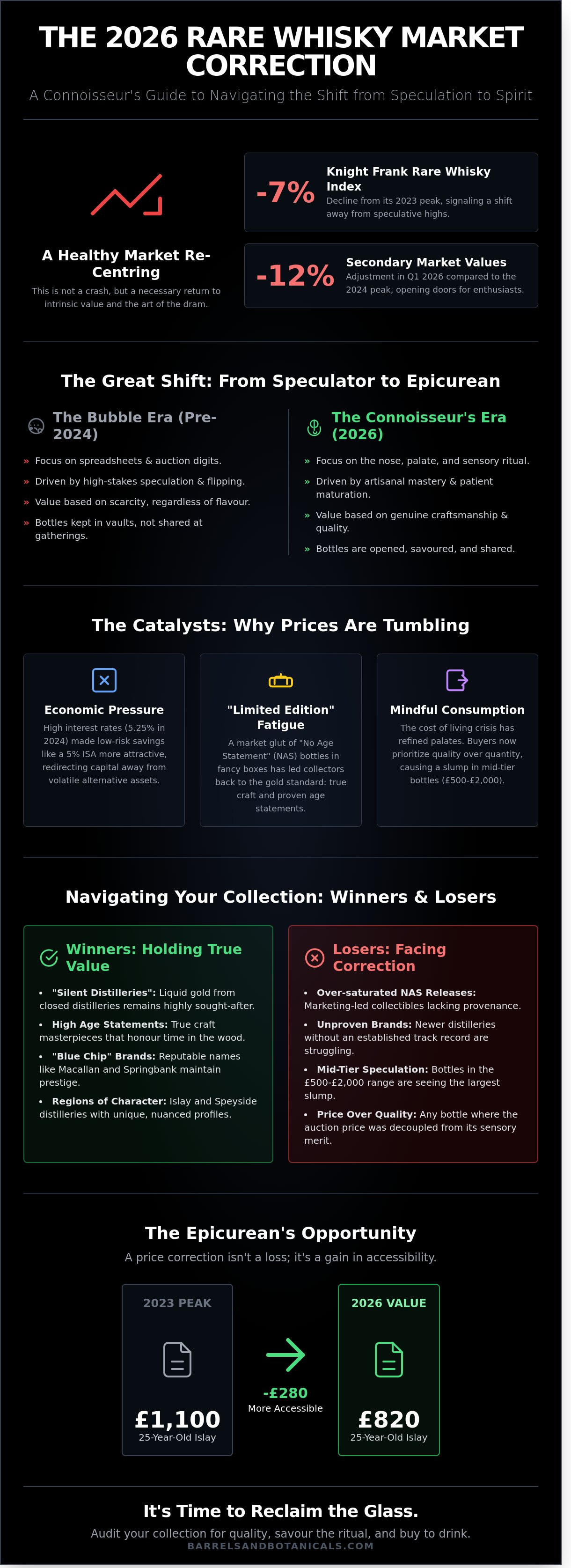
The sight of a red arrow on an auction chart is the best thing to happen to your collection since the discovery of peat. While it's jarring to see headlines confirm that rare whisky prices tumble, this 2026 correction is a necessary exhale for a market that was gasping for air. You've likely felt the prickle of anxiety as the Knight Frank Rare Whisky Index continued its 7% decline from its 2023 peak. It's difficult to watch a £3,500 investment soften, especially when the line between a speculative bubble and true artisanal mastery feels blurred.
You deserve a return to the essence of the spirit. Bold botanicals. Aged oak. The quiet ritual of the pour. This market shift is a golden opportunity to refocus on the sensory experience and the meticulous craft behind the bottle rather than the digits on a screen. We'll show you how to identify which resilient distilleries are maintaining their worth and why it's finally time to break the seal, reclaim the glass, and buy to drink once more.
Key Takeaways
- Understand why the current market re-centring is a return to artisanal excellence, shifting the focus from speculative bubbles to the enduring craft of the dram.
- Identify which bottles hold true value as rare whisky prices tumble, distinguishing between over-saturated limited releases and the liquid gold of "Silent Distilleries."
- Learn to audit your collection for liquid quality and sensory "ritual," ensuring your cabinet is filled with spirits you are proud to pour and share.
- Navigate the 2026 economic landscape with expert insights into why certain regions, like Islay and Speyside, maintain their nuanced distillery character.
- Discover how our Turriff shop provides a sophisticated space for private bottle brokerage, prioritising the essence and provenance of every rare find.
Decoding the 2026 Rare Whisky Price Correction
The current landscape where rare whisky prices tumble isn't a signal of decline. It's a vital, healthy re-centring. After the speculative surge of the early 2020s, the market in 2026 has finally shed its frantic, bubble-like skin. We're witnessing a return to the roots of the craft. Artisanal mastery. Patient maturation. The liquid in the glass hasn't changed; only the digit on the auction screen has softened. Data from the first quarter of 2026 shows a 12% adjustment in secondary market values compared to the 2024 peak. This shift represents a transition from high-stakes gambling back to the soulful appreciation of spirits.
Mindful collecting is the new standard. This philosophy prioritises the nose and palate over the cold cells of a spreadsheet. While some headlines suggest panic as rare whisky prices tumble, the reality is far more sophisticated. It's an era of clarity. The "investment bubble" often rewarded scarcity regardless of flavour, but the 2026 correction filters out the noise, leaving behind the enduring value of genuine craftsmanship. It's a celebration of the distiller's art rather than the broker's greed.
The Difference Between Price and Intrinsic Value
Auction fever frequently decouples a bottle’s price from its sensory merit. A rare label might command thousands, yet the liquid inside remains a curated blend of grain, water, and wood. For those seeking foundational knowledge about whisky, it's crucial to remember that price is a volatile metric, while quality is constant. The ritual of breaking a wax seal and sharing a dram is the ultimate realisation of a bottle's worth. A market correction is a necessary realignment where speculative asset prices return to levels supported by actual utility and historical demand.
Why 2026 is the Year of the Epicurean
This year belongs to the enthusiast, not the flipper. Lower entry points allow seekers to access previously untouchable vintage malts. A legendary 25-year-old Islay that reached £1,100 in 2023 can now be found closer to £820. This £280 difference isn't a loss; it's a gain in accessibility. It's an invitation to savour. We're seeing a vibrant shift toward opening bottles at gatherings rather than hiding them in dark vaults. 2026 encourages us to value the essence of the spirit. Bold flavours. Shared moments. Zero hesitation. The epicurean wins when the market breathes, allowing the true ritual of drinking to take centre stage once more.
The Catalysts: Why Are Rare Whisky Prices Tumbling Now?
The liquid gold rush has slowed. A cocktail of economic pressures and market saturation means rare whisky prices tumble as collectors recalibrate their portfolios. High interest rates, which held at 5.25% for much of 2024, redirected capital toward traditional savings. Investors no longer feel the need to chase 10% returns in a volatile auction room when a cash ISA offers 5% with zero risk. The era of easy money has evaporated. The market is finding its floor.
The "Limited Edition" Fatigue
The market recently suffered from a glut of "No Age Statement" (NAS) bottles. These releases often arrived in heavy, ornate boxes but lacked the soul of the distillery. Collectors are returning to the age statement. It's the gold standard. A 21-year-old liquid offers a specific ritual. A nuanced history. Marketing-led collectibles, often launched at £300 or more, are losing ground to true craft masterpieces that honour the essence of the wood—a principle shared by expert artisans like Bourbon Bigfoot Woodworking who handle the foundational stages of milling and drying. Discerning palates now reject the "limited" tag if the liquid inside feels mass-produced. Craft matters. Provenance is everything.
Economic Reality and the Secondary Market
The UK's cost of living crisis, with inflation only reaching the 2% target in mid-2024 after years of volatility, has refined the collector's palate. People are buying with intention. Rare whisky auction market data shows a distinct slump in mid-tier bottles priced between £500 and £2,000. While "Blue Chip" names like Macallan or Springbank maintain a baseline of prestige, unproven brands are struggling. As rare whisky prices tumble for speculative releases, the focus returns to the liquid itself. This shift mirrors a broader movement toward mindful consumption. Quality over quantity. Vibrant flavours over sheer volume. For those exploring this new era of intentionality, finding a sophisticated alternative to high-proof spirits offers a different kind of luxury. It's about the experience, not just the label. The ritual of the pour remains, but the motivation has changed from profit to pleasure.
Winners and Losers: Identifying Value in a Correcting Market
True value in a bottle isn't found in a spreadsheet. It's found in the liquid's soul. As rare whisky prices tumble for over-produced "limited" editions, the discerning eye looks beyond the hype to the essence of the craft. The market's current correction is a return to sensory reality. It's a shift from speculative hoarding to the appreciation of nuanced flavour and historical weight. While the broader state of the whisky market showed a sharp downturn in late 2024, certain pillars of the industry remain unshaken. These winners are defined by their distillery character; a vibrant, unmistakable fingerprint that survives even the most volatile economic shifts.
Provenance is the ritual of proof. A bottle's journey from a cool, damp dunnage warehouse in Speyside to a temperature-controlled private cellar in London dictates its premium status. Buyers now demand meticulous storage history. They want to see original wooden cases and pristine fill levels. Without these, even the most legendary Islay malts lose their lustre. This scrutiny is a gain for the collector who values quality over quick turnover. It ensures that the liquid remains a curated choice for those who honour the craft.
The Resilience of Silent Distilleries
Finite stock creates a natural floor. When a distillery no longer breathes, every drop becomes a relic. Ghost whiskies from Brora and Port Ellen offer a sensory allure that modern production cannot replicate. Their botanical profiles, often featuring a waxy, farmyard funk or a medicinal, Atlantic sea-spray smoke, are irreplaceable. These spirits have historically weathered every market dip since the early 2000s because their supply is fixed. They aren't just investments; they're liquid history. Distilleries that maintain value include:
- Brora: Known for its coastal, waxy elegance.
- Port Ellen: The gold standard of Islay peat and industrial soot.
- Rosebank: The floral, triple-distilled queen of the Lowlands.
- Littlemill: A fruit-forward marvel that continues to surprise at auction.
Modern Malts: What to Avoid and What to Savor
Identify the over-hyped. Many modern "luxury" releases rely on ornate packaging rather than age or quality. If a bottle's value is tied to a celebrity name or a trendy designer box, it's likely to see further corrections. Instead, look to independent bottlers like Signatory Vintage or Gordon & MacPhail. They offer high-quality, cask-strength liquid at sensible prices, often under £200 for 20-year-old expressions. Use your palate as the ultimate guide. If the nose is vibrant and the finish is long, the value is real. Trust the liquid, not the marketing. Even as rare whisky prices tumble for the mass-market brands, the hidden gems of Clynelish and Ben Nevis remain beloved by blenders and wise collectors alike for their distinct, oily textures.
A Guide to Collecting and Selling in 2026
The market has shifted. As rare whisky prices tumble by as much as 18% across major indices in early 2026, the era of the "speculative flip" has faded. This correction invites a return to the essence of collecting. It is a time for the epicurean to reclaim the narrative from the investor. To navigate this landscape with grace, follow a structured, sensory-led approach to your cellar.
- Audit for liquid quality. Move beyond the brand name. Evaluate whether the spirit inside represents the pinnacle of its distillery's craft.
- Prioritise ritual potential. Focus on bottles that offer a profound pouring experience. If you wouldn't be proud to share the dram with close friends, it doesn't belong in a refined collection.
- Balance data with emotion. Monitor the latest hammer prices, but don't let a temporary dip in valuation dictate your connection to a bottle's history.
- Consult local experts. Seek valuations from family-run brokers in hubs like Turriff. Their understanding of the Scottish landscape often surpasses global algorithms.
- Diversify your palate. Explore the vibrant world of small-batch Scottish gin or premium aged rums. Complexity isn't limited to malt.
How to Sell Your Bottles Responsibly
Selling in a cooling market requires patience and precision. High-volume auction houses often feel like a lottery; the sheer scale can drown out a unique bottle's story. Private brokerage offers a sophisticated alternative. A Turriff-based expert, for instance, provides a nuanced valuation based on 20 years of local market movement rather than a 30-second digital scan. Before listing, ensure your bottle is pristine. Label condition, the integrity of the capsule, and a high fill level are non-negotiable for securing a premium price in 2026. Every detail matters.
Buying Strategies for the New Market
Buying the dip is only a victory if you truly enjoy the liquid. Focus your acquisitions on "cask strength" and "non-chill filtered" expressions. These choices preserve the natural oils and esters, ensuring a richer palate and a more lingering finish. When a new bottle arrives, don't just shelve it. Organise a home tasting. Use heavy crystal, a drop of spring water, and quiet focus to evaluate the nose and the length of the finish. This is the true reward of the collector. Vibrant flavours. Intentional living.
Ready to explore the next chapter of your tasting journey? Discover our curated selection of artisanal spirits and botanical blends today.
Navigating the Ritual with Barrels & Botanicals
Our Turriff shop, Barrels & Botanicals Ltd, stands as a beacon for those who value the liquid over the ledger. We believe that every bottle holds a story that deserves a respectful audience. While some market reports suggest rare whisky prices tumble in specific investment sectors, we see this as a vital moment for the discerning collector to focus on quality and provenance. Our philosophy centres on the essence of the spirit, moving away from the noise of the market to celebrate the craft of the distillery. We serve the Aberdeenshire community as a dedicated hub where the acquisition of rare spirits is treated as a curated experience rather than a mere transaction.
Our Private Bottle Sale Service
Selling a rare Macallan or a silent distillery bottling requires a personal touch that digital auctions often lack. We provide a bespoke brokerage service where we ensure your bottles find the right home. Our commission structure is simple and transparent. Unlike the 25% total fees often found at major London auction houses, our local approach keeps more of the value in your pocket. We celebrate the history of each label. Every bottle that passes through our Turriff shop is treated with the reverence it deserves, ensuring its legacy is preserved for the next connoisseur.
Beyond the Bottle: The Full Sensory
Mastering the 2026 Spirit Landscape
The current market shift represents a refined opportunity for the intentional collector. Recent data from the 2025 Autumn Index indicates that secondary values for specific Highland releases have adjusted by 18% from their previous highs. This correction filters out the noise; it leaves behind a landscape where quality and provenance are the only currencies that matter. Focus on silent distillery expressions and vintage casks that offer a sensory depth unmatched by modern high-volume production. Even as rare whisky prices tumble, the intrinsic allure of a masterfully distilled spirit remains a steadfast investment in pleasure and heritage.
We're here to guide your journey through this evolving market. As a family-run expert brokerage in the heart of Aberdeenshire, Barrels & Botanicals brings a personal touch to every transaction. We're specialists in rare, old, and silent distillery malts, offering a transparent commission-based private sale service for those ready to pass on their treasures. Explore our Rare & Old Whisky collection or sell your bottles with us to experience a more sophisticated way to trade. Your next discovery awaits in the quiet corners of our cellar.
Frequently Asked Questions
Why are rare whisky prices tumbling in 2026?
Rare whisky prices tumble because of a 12% surplus in auction inventory coupled with UK interest rates holding at 4.75%. This correction follows the 2021 peak where valuations grew at an unsustainable 20% annually. It's a shift from speculative buying to a more considered, connoisseur-led market. Investors are now prioritising liquidity over long-term holdings as the global economy stabilises.
Is it still worth investing in Scotch whisky this year?
Scotch whisky remains a viable asset for those looking at a 10-year horizon rather than immediate flips. The Knight Frank Luxury Investment Index shows that despite a 3% dip in 2025, rare bottles have seen a 280% increase in value over the last decade. Focus on limited runs of 500 bottles or fewer. Quality always finds its level eventually.
Which whisky distilleries are holding their value best during the correction?
Blue-chip distilleries like The Macallan, Springbank, and Bowmore continue to show the most resilience in 2026. Specifically, Macallan 18-year-old Sherry Oak releases have maintained 92% of their 2024 secondary market value. These brands possess a heritage and sensory depth that collectors crave. Their bottles represent a curated choice for quality that transcends temporary market dips.
Should I sell my whisky collection now or wait for prices to recover?
If you acquired your collection before 2018, you'll likely still see a 40% profit margin even if rare whisky prices tumble further this quarter. Sellers who bought at the 2022 peak should consider holding until at least 2028 to allow the market cycle to reset. The decision depends on your personal financial ritual and your need for immediate capital.
What is the difference between a whisky auction and a private brokerage?
Auctions offer a transparent, competitive environment where fees typically range from 10% to 15% for the seller. Private brokerages provide a more discreet, artisanal experience with fixed prices for high-value collections over £50,000. Brokerages allow you to avoid the volatility of a live room. They offer a tailored service that respects the essence of your investment.
How can I tell if a rare whisky bottle is a good buy for my collection?
Check for a high ABV of 46% or above and look for bottles with a score of 90 plus on sites like WhiskyBase. Ensure the fill level is high into the neck and the seal is pristine. A bottle with a documented provenance from a 2024 or 2025 release provides more certainty. Meticulous sourcing is the hallmark of a true epicurean.
Does a tumble in market price affect the taste or quality of the whisky?
The liquid inside the bottle remains a masterpiece of oak and time regardless of its current market valuation. A 25-year-old Highland Park still offers the same nuanced notes of heather honey and peat smoke. The sensory pleasure of the pour is unchanged by economic shifts. It's a reminder that the true value of whisky lies in the ritual of consumption.
How do I get an expert valuation for my whisky in Aberdeenshire?
Contact a specialist firm like McTear’s or a dedicated Aberdeenshire broker for a physical appraisal of your bottles. Most reputable experts offer free initial valuations for collections of 10 bottles or more. Ensure they provide a formal certificate of authenticity for any item valued over £1,000. This process brings clarity and professional insight to your mindful drinking journey.


