

A £1.5 million hammer price at a 2025 Sotheby’s auction isn't just a record; it is a testament to a century of silent maturation and the artisan’s touch. You recognise that true luxury demands more than a high price point. It requires a story. It requires soul. We agree that the fear of a counterfeit bottle or the dense jargon of a London auction house can turn a moment of celebration into one of hesitation. The nuance of the peat or the vibrancy of the oak should be the focus, not the anxiety of a misinformed purchase.
For enthusiasts who want to take their appreciation a step further and experiment with the aging process themselves, you can find premium small-format barrels to create your own unique spirits. To see a range of options, click here.
You deserve to command the market of expensive whiskey with the poise of a master blender. This guide provides a definitive framework to evaluate rarity, decode age statements, and distinguish between a liquid investment and a sensory masterpiece. We’ll examine the 2026 market landscape; from the chemical nuances of the finish to the essential rituals of the perfect pour. Bold history. Rare glass. Absolute clarity.
Key Takeaways
- Identify the intersection of scarcity, time, and intuition that justifies the price of expensive whiskey in today’s global market.
- Discover how bespoke cask finishing and decades of ageing shape the sensory profile, preserving a rare spirit’s nuanced nose and palate.
- Navigate the 'liquid gold' market with confidence by determining if your primary goal is long-term financial appreciation or a sensory celebration.
- Master the essential collector’s protocol to verify provenance and authenticity, ensuring every addition to your cellar is a genuine, untampered masterpiece.
- Explore the art of intentional sourcing to secure the most refined Scottish spirits and elevate your private collection through expert guidance.
Defining the Exceptional: What Makes a Whiskey Truly Expensive?
To hold a bottle of truly expensive whiskey is to grasp a piece of liquid history. It isn't just about the price tag. It's about the soul of the spirit; the master blender's intuition; the slow, rhythmic pulse of the seasons. While Single Malt Scotch remains the gold standard for many collectors, global rarities from Japan and historic Kentucky ryes now command similar reverence. The market has shifted. We no longer see these bottles as mere beverages. They are curated collectibles. Assets in glass. In November 2023, a single bottle of Macallan 1926 fetched a record-breaking £2.1 million at auction, proving that the ceiling for rare spirits continues to rise.
The transition from retail premium to auction-house "white whale" depends on a delicate intersection of factors. It's a world where the nose, palate, and finish are balanced against historical provenance. Collectors look for:
- Distillation Date: Spirits produced during specific eras of a distillery's history.
- Cask Quality: The specific influence of first-fill Sherry or rare European oak.
- Artistry: The hand-signed guarantee of a Master Distiller.
When you seek an expensive whiskey for a gift or a private collection, you aren't just buying alcohol. You're investing in a ritual. The weight of the crystal decanter, the depth of the amber hue, and the knowledge that the liquid inside can never be replicated all contribute to its prestige.
The Role of Scarcity and Ghost Distilleries
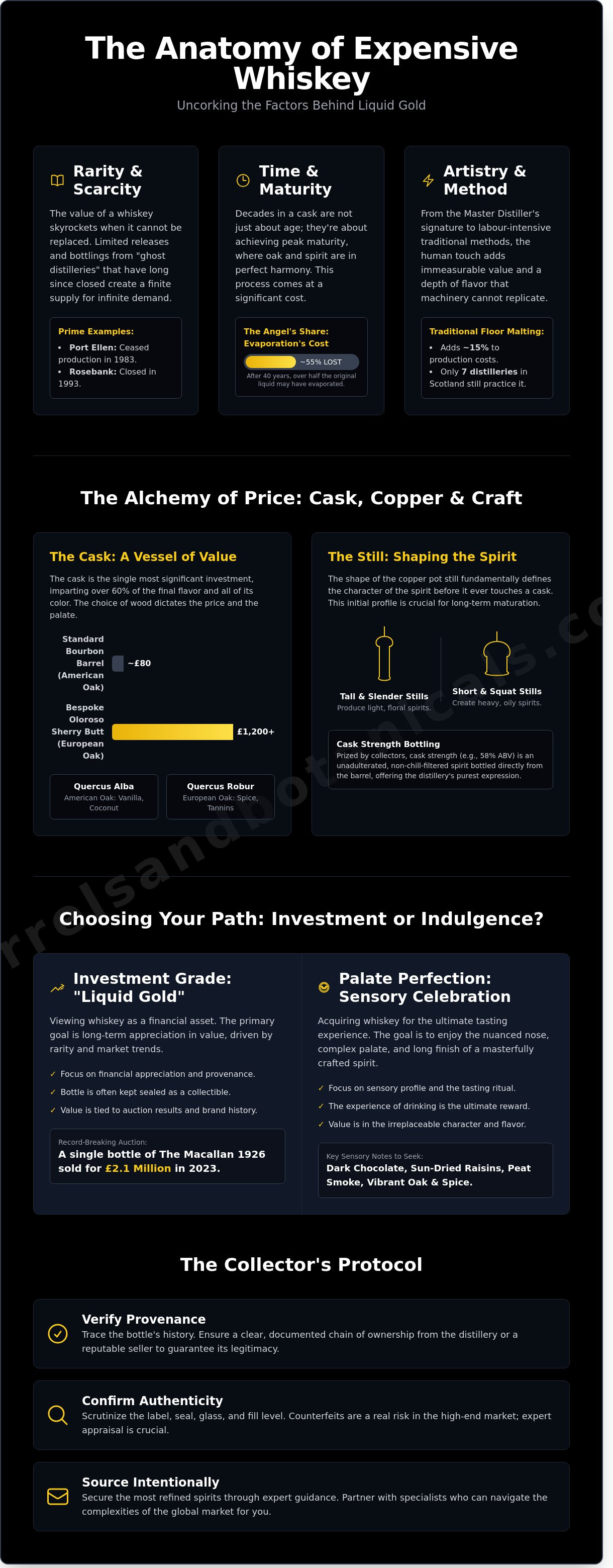
Silence has a price. Ghost distilleries, those "silent" sites that no longer produce spirit, offer a finite supply that dwindles with every bottle opened. Port Ellen, which ceased production in 1983, and Rosebank, closed in 1993, represent the pinnacle of this scarcity. When a release is limited to 1 of 100 bottles, the value increases exponentially. It's about the impossibility of replacement. Heritage dictates the market, and a distillery's historical provenance acts as a blueprint for its future value.
Age Statements vs. Maturity
Time is a thief. The "Angel's Share" refers to the literal cost of evaporation, where roughly 2% of a cask's volume vanishes into the air every year. By the time a spirit reaches 40 years of age, more than 50% of the original liquid may be gone. This evaporated essence creates a natural premium. However, age is a delicate dance. If a spirit sits too long, the wood tannins can overpower the vibrant botanicals of the original distillate. True maturity is the point where the oak and the essence of the grain reach a perfect, nuanced harmony.
The Alchemy of Price: Age, Cask, and Botanical Nuance
True luxury is felt before it is tasted. When you hold a bottle of expensive whiskey, you aren't just holding a liquid; you're holding decades of silent transformation. The price reflects a rigorous commitment to ancient methods that most modern producers have abandoned. Only seven distilleries in Scotland still practice traditional floor malting, a labour-intensive process that adds approximately 15% to production costs. This technique, requiring maltmen to turn the grain by hand every eight hours, produces a depth of flavour that machinery cannot replicate. Bold botanicals. Patient craft. Pure essence.
The sensory impact of a rare spirit is defined by its journey through copper. Tall, slender pot stills produce a light, floral spirit, while shorter, squat stills create a heavy, oily character. Over half a century, the 'nose' of such a spirit must be protected from the harshness of oxidation. This is why 'cask strength' is so highly prized among collectors in Turriff. Bottled directly from the wood at perhaps 58% ABV, it offers an unadulterated experience. It is the raw heartbeat of the distillery, untouched by chill-filtration or dilution. It invites you to engage in a mindful tasting ritual that rewards the patient palate.
The Influence of Wood and Terroir
The cask is the most significant investment in the lifecycle of a premium spirit. While a standard American bourbon barrel might cost £80, a bespoke Oloroso Sherry butt from a Spanish cooperage can exceed £1,200. These rare European oak casks breathe life into the spirit, imparting vibrant notes of dark chocolate and sun-dried raisins. The micro-climate of the warehouse plays a vital role too. In the cool, damp air of Aberdeenshire, the 'angel's share'-the 2% of liquid lost to evaporation each year-concentrates the remaining sugars, ensuring a rich, velvet-like texture that justifies the tag of an expensive whiskey.
- Quercus Robur: European oak providing tannins and spice.
- Quercus Alba: American oak offering vanilla and coconut sweetness.
- The Cooper's Craft: Ensuring structural integrity for 50+ years of maturation.
The Master Blender’s Curation
A master blender's work is a ritual of precision. They may nose 20,000 casks just to find one exceptional outlier that possesses the 'unicorn' quality required for a prestige release. Blending is not about hiding flaws; it's about creating a symphony. By marrying a 40-year-old vintage with a 10-year-old 'finishing' cask, the blender creates layers of complexity. The finish is the hallmark of this luxury. It is the ghost of the liquid that remains on your tongue long after the glass is empty. You'll find lingering notes of old tobacco, charred orange peel, and warming clove. This is the gain of quality over quantity. Sophisticated. Nuanced. Unforgettable.
Investment Grade vs. Palate Perfection: Choosing Your Path
Deciding on a high-value bottle in Turriff starts with a single question: is this for the vault or the velvet chair? You must identify your primary goal. Financial appreciation demands a cold, analytical eye. Sensory celebration requires a passionate heart. The "liquid gold" market isn't just hyperbole. Over the ten years leading into 2024, the Knight Frank Rare Whisky Index recorded a 373% increase in value. This growth surpassed gold, fine art, and classic cars. Yet, the price of an expensive whiskey doesn't always correlate with the pleasure it provides on the tongue.
Opening an investment-grade bottle carries a distinct risk profile. Once the wax seal breaks, the financial asset vanishes. You're left with a drink. It might be a transcendent drink, but its value as a tradable commodity drops by 80% or more instantly. Many of the most sublime spirits aren't the most costly to acquire. They're often hidden gems from independent bottlers that prioritise liquid quality over marketing budgets. These bottles offer the complexity of age without the premium of a global brand name.
The Investment Framework
Success in the secondary market relies on two pillars: distillery prestige and pristine condition. Collectors look for "The Big Three" names like Macallan, Ardbeg, or Bowmore. Every detail matters. Original packaging, unblemished labels, and certificates of authenticity are non-negotiable. Looking toward 2026, market data suggests a shift in focus. While Scotland remains king, premium Irish whiskey is projected to see a 7.2% compound annual growth rate. Savvy collectors are now securing limited releases from the Midleton and Waterford distilleries to diversify their portfolios for the long term.
The Connoisseur’s Drinking Guide
The true epicurean seeks the "sweet spot" of the craft. This often means finding 25-year-old expressions from lesser-known distilleries that offer the depth and oiliness of a 50-year-old flagship. It's about the ritual. Use a tapered Glencairn glass to concentrate the esters. Add a single drop of room-temperature water to "open" the spirit. This releases hidden aromatics. A nuanced flavour profile is the real prize. You aren't just buying expensive whiskey; you're investing in a moment of clarity. Bold peat. Delicate heather. Lingering smoke. These are the rewards of a curated choice made for the palate rather than the pocketbook.
The Collector’s Protocol: Provenance, Storage, and Authenticity
Acquiring a rare bottle is a ritual of patience and precision. It's an investment in liquid history. When you're seeking expensive whiskey in the heart of Aberdeenshire, the pursuit requires more than a keen palate; it demands a forensic eye. The secondary market carries inherent risks. A 2018 study by the Scottish Universities Environmental Research Centre revealed that nearly 40% of rare bottles tested were either outright fakes or did not contain spirit from the year stated on the label. To protect your capital, you must look beyond the liquid. Professional brokerage services often act as the first line of defence, using carbon dating and glass analysis to verify age. For the individual collector in Turriff, the safest path remains the established, family-run retail outlet where every bottle has a clear, verifiable paper trail.
Ensuring Authenticity and Traceability
Provenance is the documented chain of ownership that guarantees a bottle's legitimacy. Without this history, the value of a rare spirit can vanish instantly. When inspecting a potential purchase, focus on these physical markers:
- Label Integrity: High-resolution printing should be sharp. Look for glue residue or uneven edges that suggest a label has been reapplied.
- The Seal: Check the lead or plastic capsule for signs of tampering. Any pinpricks or loose fits are immediate red flags.
- Ullage Levels: The "fill level" should be consistent with the bottle's age. An unusually high level in a 40-year-old bottle suggests a modern refill.
- Cork Condition: A healthy cork remains firm. If the cork has crumbled or shows significant weeping, the spirit’s vibrant essence may be compromised.
The Ritual of Storage
Protecting your investment means mastering the environment. Unlike wine, high-end spirits must always stand upright. Constant contact with high-proof alcohol will eventually degrade the cork, tainting the complex flavour profile you've paid to preserve. Temperature stability is the priority. Aim for a consistent 15 to 18 degrees Celsius. While many assume a traditional stone cellar is ideal, these spaces often suffer from excess dampness that peels labels and destroys resale value.
Light is the enemy of the "nose" and the "finish." UV rays bleach the natural oils and botanical nuances of the wood-aged spirit. Keep your collection in total darkness, preferably within their original wooden presentation cases. Humidity should hover around 60%. This balance keeps the cork from drying out without inviting mould. By treating the storage process with the same reverence as the distillation itself, you ensure the liquid remains a pristine snapshot of its era. If you are ready to elevate your collection with a verified masterpiece, explore our curated selection of rare spirits and begin your investment journey today.
Sourcing the Exceptional: The Barrels & Botanicals Selection
Our commitment to the craft begins with a simple truth. A truly great spirit is not merely a drink; it's a liquid history. At Barrels & Botanicals Ltd, we've spent years cultivating relationships with independent bottlers and private estates to ensure our shelves in Turriff hold only the most nuanced Scottish spirits. We don't settle for the commonplace. Instead, we hunt for the vibrant, the rare, and the forgotten. This family-run approach allows us to offer a level of personal knowledge that larger retailers simply can't replicate. We know the story behind every label because we've lived the ritual of its discovery.
For those seeking a gift that transcends the ordinary, investing in a bottle of expensive whiskey is a gesture of profound respect. These are liquids that have breathed through oak for decades, absorbing the essence of the Highlands or the salt spray of the Islay coast. Our private bottle sale service acts as a vital bridge for collectors. Whether you're looking to acquire a piece of distilling history or find a home for a cherished bottle, we facilitate these exchanges with the discretion and expertise that connoisseurs expect. It's about more than a transaction. It's about stewardship.
Our Curated Range of Rare Whiskies
We focus our energy on old and rare Single Malt Scotch that balances historical weight with exceptional flavour profiles. We look for bottles that tell a specific story, such as a 1990s vintage from a silent distillery or a limited run finished in exotic wine casks. Every selection must meet our rigorous standards for the nose, palate, and finish. If you're looking to explore this world from the comfort of your home, our guide to buy rare scotch online UK provides a detailed roadmap for finding these elusive treasures.
Elevating the Experience
The ritual of a premium spirit is often completed by the perfect accompaniment. We've carefully selected a range of New World and Cuban cigars to create a sensory synergy that elevates the drinking experience. The smoke and the spirit should dance, not compete. Our team provides bespoke advice on pairings, ensuring your expensive whiskey is enjoyed exactly as the master blender intended. Deep notes. Rich textures. Pure indulgence.
- Personalised consultations for those looking to sell my whisky collection Scotland.
- Expert guidance on cigar and spirit flavour profiles.
- A community of mindful drinkers who value quality over quantity.
Join the Barrels & Botanicals Ltd community today. We invite you to slow down and savour the craftsmanship that goes into every bottle we source. Whether you're a seasoned collector or a newcomer to the world of fine spirits, we're here to guide your journey with passion and clarity.
Secure Your Legacy in Liquid Gold
Mastering the 2026 market means looking beyond the label to the liquid's lineage. True refinement lies in the intersection of cask chemistry and verified provenance. You aren't just buying a bottle; you're preserving a moment of distilled history. Since 2019, our family-run collective has specialised in the nuances of old and rare malts, ensuring every acquisition meets the highest standards of authenticity. For those seeking the pinnacle of expensive whiskey, our private bottle sale and brokerage service provides a direct line to the world's most elusive distilleries. We focus on the sensory gain of every drop. The vibrant nose, the complex palate, and the lingering finish of a 30-year-old vintage are the rewards of a well-curated cellar. Every ritual matters, from the temperature of the room to the weight of the crystal in your hand. Explore our curated selection of rare and exceptional whiskies today. Your journey into the heart of the barrel starts with a single, intentional choice. Embrace the extraordinary.
Frequently Asked Questions
Why is some whiskey so much more expensive than others?
Whisky prices are primarily driven by age, rarity, and the meticulous maturation process in specific casks. A 50 year old Scotch loses approximately 60% of its original volume to evaporation over five decades, making the remaining liquid incredibly scarce and costly to produce. Rare wood types, such as Japanese Mizunara oak which can cost over £3,000 per cask, also significantly inflate the final retail price.
Is expensive whiskey actually better to drink?
Higher price points generally reflect a more complex sensory experience, though personal preference remains the ultimate guide. An expensive whiskey often provides a more nuanced palate with layers of dried fruits, old leather, and delicate smoke that cheaper bottles cannot replicate. These premium spirits are designed for a slow ritual, where the finish lingers for several minutes rather than disappearing instantly.
What is the most expensive bottle of whiskey ever sold?
The Macallan 1926 Adami holds the record for the most expensive bottle ever sold at auction. It reached a staggering price of £2.1 million at Sotheby’s in London during November 2023. This specific bottle is one of only 40 produced from cask number 263, making it the pinnacle of rare spirits and a legendary prize for global collectors.
How should I store an expensive bottle of whiskey to keep its value?
You must store your bottle upright in a temperature controlled environment between 15°C and 18°C to preserve its integrity. Unlike wine, spirits will degrade the cork if left on their side, leading to leaks or tainted flavours. Keep the bottle in total darkness to prevent UV rays from bleaching the natural colour or damaging the delicate chemical compounds within the liquid.
Can I sell my expensive whiskey through a private broker?
Private brokers and specialist auction houses are the most effective channels for selling high value bottles to serious investors. Most reputable brokers charge a commission fee ranging from 10% to 15% of the final hammer price. They provide essential valuation services and access to a global network of buyers, ensuring your asset reaches its full market potential in the current economic climate.
What is the 'Angel's Share' and how does it affect price?
The Angel's Share refers to the natural evaporation of spirit through the porous oak staves of the barrel during ageing. In the cool Scottish climate, distilleries lose roughly 2% of their inventory every year to the atmosphere. This steady reduction in volume means that older whiskies are naturally more expensive because there is simply less liquid left to bottle after decades in the warehouse.
How do I know if a rare whiskey bottle is authentic?
Authenticity is verified through a combination of provenance records, glass analysis, and carbon dating for extremely old vintages. Rare Whisky 101 reported in 2021 that nearly 10% of rare bottles tested from the secondary market were found to be fakes. Always check for consistent fill levels, high quality label printing, and intact tax strips before committing to a significant purchase from a private seller.


